


Nyheter
EWA-Norge 2026: Keeping a Space Open for Children to Learn, Create and Belong
Most of us who read this had the chance to go to school, learn to read, and find our place in the world.
For many children growing up in rural communities in Bangladesh and India, life is far less secure. Families struggle with rising prices, debt, unstable incomes and, increasingly, the effects of floods and climate change. For many, simply getting through each month is a challenge.
Yet children are children everywhere. They are curious, creative, eager to learn and eager to belong.
For many years, EWA-Norge has supported a simple idea: every child deserves a safe place where they can learn, express themselves, discover their abilities and spend time with others in a positive environment.
Through music, art and cultural learning, children find exactly that.
Small Activities That Make a Difference
Across villages in northern Bangladesh and eastern India, local artists, musicians and teachers work regularly with children throughout the year.
The activities are simple:
Learning and singing traditional songs
Playing string, percussion and wind instruments
Painting with natural and plant-based colours
Learning from local artists and musicians
Sharing knowledge with younger children
Today, around 700 children and young people take part in these activities.
Some learn painting. Others learn music. Many participate in group activities that bring together children from different backgrounds, faiths and families.
Everything is provided free of charge.
For many children, these classes are the only opportunity they have to participate in organised cultural activities outside school.
More Than Music and Art
The children attend regular schools. The music and art programmes are not a replacement for formal education. They are an addition to it.
Parents and teachers often tell us that children become more confident, more focused and more willing to participate both in school and in community life.
The benefits are not only educational.
Children learn patience and discipline. They learn to cooperate with others. They learn to stand in front of a group and express themselves. They discover that their ideas matter and that their voices can be heard.
For many girls, this can be particularly important. In communities where opportunities often become more limited during adolescence, having a safe place to learn, create and build confidence can make a lasting difference.
Knowledge Passed On
One of the most encouraging things we see is that children do not remain only learners.
Many who joined the programme as young children return later as assistants, musicians or teachers. They help younger children learn the same songs, skills and traditions that were passed on to them.
In this way, knowledge stays alive within the community.
A song is passed from one generation to the next.
A painting technique survives because someone takes the time to teach it.
Local cultural traditions continue because young people choose to carry them forward.
Even when participants move away or follow different paths in life, they take something with them: friendships, confidence, skills, memories and a sense that they have something valuable to contribute.
A Grassroots Effort
This is not a large development project.
There are no expensive offices, large administrative structures or international consultants.
The work depends on local teachers, artists and musicians, supported by a small group of committed people in Norway.
That is one of its strengths.
It is also why financial support matters so much.
In recent years costs have risen significantly, especially in Bangladesh. Materials cost more. Transport costs more. Local families face increasing economic pressure. Maintaining regular teaching and activities has become more difficult.
The enthusiasm of the children has not diminished.
The commitment of the teachers has not diminished.
The need has not diminished.
What has become harder is finding the resources needed to keep the activities regular and stable.
Why We Need Your Help
EWA-Norge receives no regular public funding for this work.
Around 20% of our costs are currently covered through contributions from individual supporters, friends and foundations. The rest must be raised each year.
Your support helps provide:
Regular teaching by local artists and musicians
Musical instruments and maintenance
Art materials and natural pigments
Support for local teachers and assistants
Continuity throughout the year
A safe and welcoming place where children can learn, create and spend time together
We are not asking you to solve the world's problems.
We are asking you to help keep something valuable alive.
Every week, children come together to learn music, create art, share experiences and build friendships. They come because these activities matter to them.
With your support, this work can continue.
Thank You
In a world that often feels divided and uncertain, it is easy to believe that small efforts do not matter.
We believe they do.
Every child who finds encouragement, friendship, confidence and creative expression carries something positive into the future.
This is the work EWA-Norge seeks to support, quietly and consistently, year after year.
It may be a small contribution in a very large world.
But it is real.
And with your help, it can continue.
Please help us keep these spaces open for children to learn, create and belong.
EWA-Norge
EarthCare with Art, Yoga and Music
www.ewa-norge.no

Mangfoldig maleriutstilling i Mela-huset
Bildene vi fikk se på veggene i Mela-huset i Oslo den nest siste helgen i november, ga både farger, lys og håp i høstmørket. Utstillingen var kalt «Barn maler med plantefarger».
Berit Nyman
Kunstnerne er nemlig barn og unge voksne i fattige områder i India og Bangladesh, som har lært både å lage sine egne plantefarger, og å male bilder.
Dette er et grasrotprosjekt opprettet og ledet av lokale kunstnere og lærere, i tett samarbeid med den frivillige organisasjonen EWA-Norge. Forfatteren Wera Sæther, som har kuratert utstillingen i Melahuset, er styremedlem i EWA-Norge og har tett kontakt med dem som er med i det indiske prosjektet. Det samme gjelder organisasjonen for folkemusikk nord i Bangladesh, også den støttet av EWA-Norge.
Bildene er blitt valgt ut lokalt i en nøye gjennomført prosess, og deretter fraktet til Norge av EWA-Norge. Det endelige utvalget av bilder til utstillingen ble gjort etter at de var kommet til Norge.
Ved utstillingsåpningen som var lagt til den internasjonale barnedagen 20. november, fortalte Sæther om både utstillingen og prosjektet som hun har besøkt en rekke ganger. En representant fra den indiske ambassaden i Norge var også til stede, sammen med et trettitall interesserte publikummere.
De unge kunstnerne har lært å samle bær, blomster, blader og røtter som de knuser, presser og bearbeider til naturlige pigmenter. Fargene blandes med limstoff som de selv har utviklet. Av denne malingen lager de kunstverk fulle av liv og originalitet.
I filmklipp fikk publikum også se maleprosessen.
– Denne utstillingen handler ikke bare om kunst, men om livskraft, læring og fellesskap, understreker styret i EWA-Norge.
Gjennom helgen var om lag 80 besøkende innom lokalene i Melahuset og fikk se utstillingen.
We have visited the music schools in Bangladesh

In the end of December, three of us from the board traveled to Bangladesh to visit all the the music schools. We got to hear a lot a fantastic singing, and meet many beautiful children and teachers. We have an abundance of video footage and photographs that we want to share.
They are doing a big and beautiful work to keep the “boat” alfoat. Every child is taken care of. They don’t want anyone to fall out of the “boat”. There is alot of dangerous drugs in the area, so it’s easy for the older children to get trapped by them if they are not careful. The girls are being married away when they reach that age. Many are not allowed to keep singing after that. Even so, the teachers and children keep the song “boat” going strong.
New solar panels in Kolkata
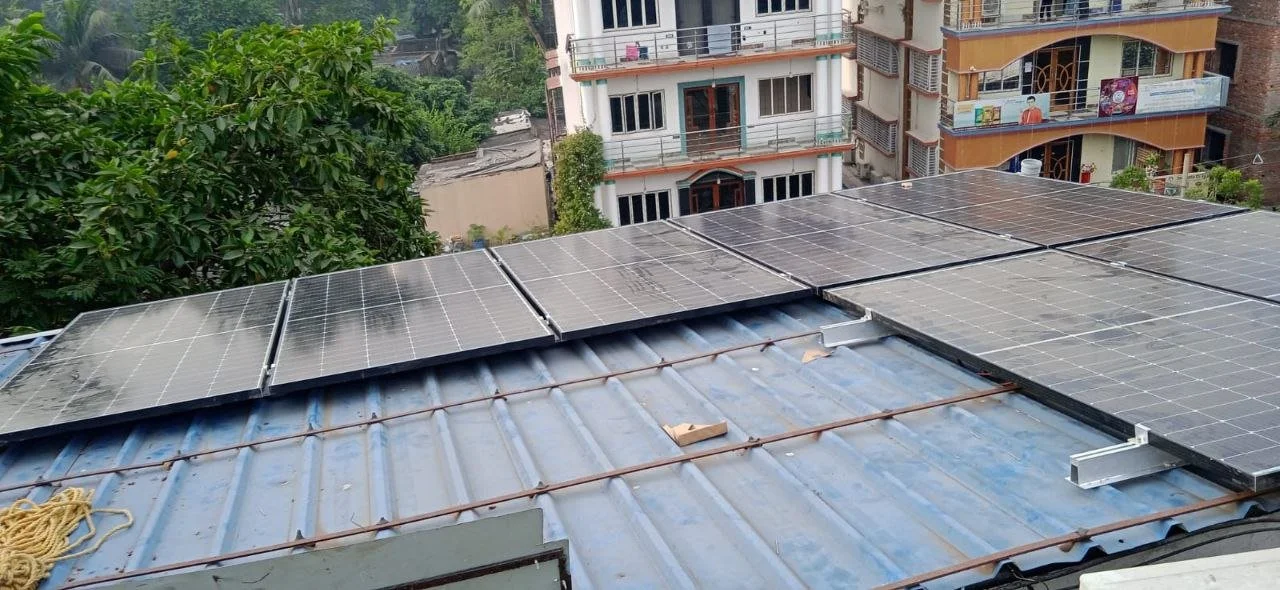
We have had a successful fundraiser. We got enough to both reinforce the roof structure and install the solar panels. Most of the electricity consumption is covered by the new solar panels. Which means that the monthly electricity bill is minimal. And we have made a small difference by replacing some coal power production.
We want to thank everyone who helped make this possible!
Food
What has changed since 2018. The whole world, one could say. Climate change is ongoing. South Asia is particularly vulnerable to floods and droughts. All schools were closed for almost two years during the pandemic. The invasion in Ukraine has major consequences for the production and transport, and therefore price of necessary food.
EWA-Norway managed to keep the boat with children's art afloat through the pandemic. Join us and keep it going during inflation too.
Young and older artists must be allowed to eat.
Our new place
In February, children started gathering to paint together on Sunderban. More than 70 children have joined. 100 more are on the waiting list.
Happy news
Together with our local co-workers, we (in EWA-Norway) are now very happy to announce that a new painting place will be opened, for children in Sundarban (which means "beautiful forest").
This class will be held on an island - literally in the ocean gap. More information on this is coming soon! More than a 100 children attended the first class, with eager parents standing behind them.
Around twenty girls and young women (former students in our classes in Kolkata and the villages in Nadia) are now co-responsible for the teaching of painting and yoga to the younger ones.
They are modestly paid for the work they do. This is also a work of empowerment.
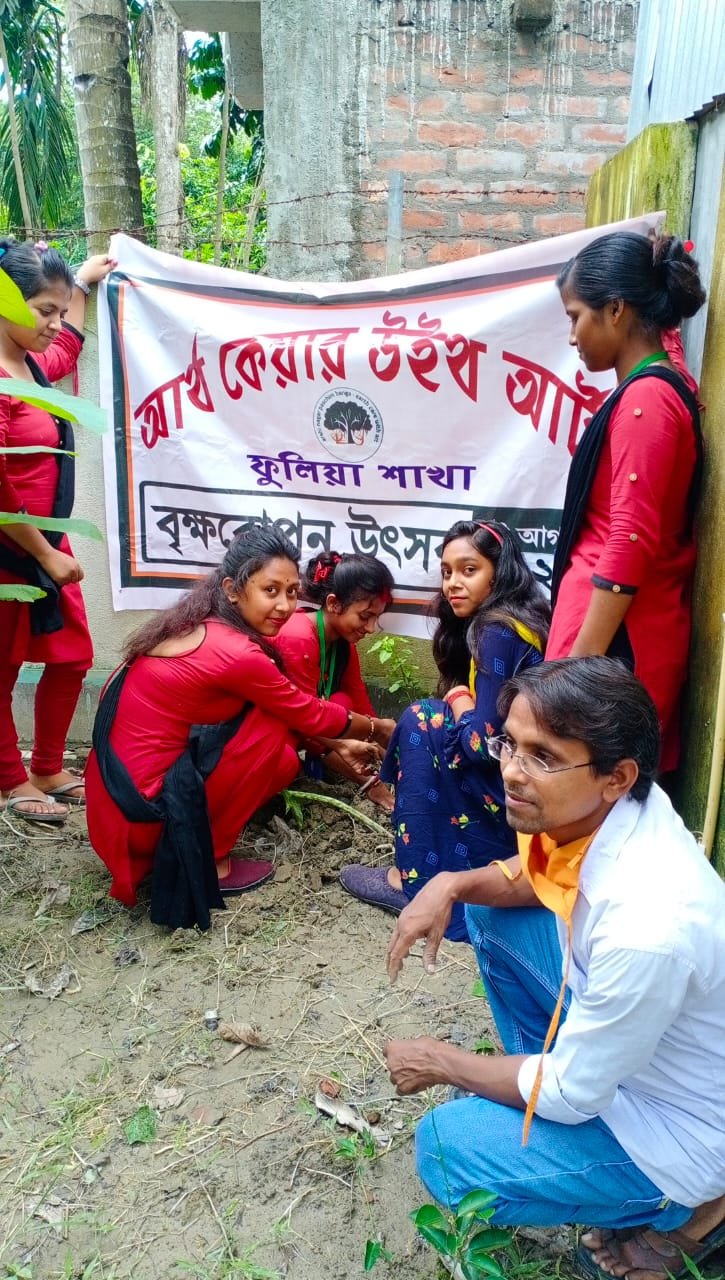
They are planting trees!
The yong and old in Earth Care With Art India have planted trees on the anual tree planting day.



A new place
In Bangladesh: Devoted Nishi has been searching for two years for a place where children would come to teach. A flock of twenty-five eager seven-eight-year-olds. We call the place Mayalay. Each place has a similar name: Sahajalay, Suralay, Sebalayosv. Alay means «place».
In India: In the suburbs, near the weaving villages, our Indian staff has opened a new teaching place for painting. It is the children of indigenous people who come. Until now, smaller gatherings have been able to take place within the limits of the pandemic restrictions.
But: a third wave of infection is raging in both countries. We follow from day to day!
They can meet again!
Finally the lockdown restrictions are midler in Bangladesh and India. The children can meet in small groups again!
An update
There is complete lockdown in Bangladesh and India. All ours are asked to write: daily reports, diaries, stories, songs.
The corona situation is more unclear in Bangladesh than in India. Tiny movements outside your own home are possible, but no more. People are "stuck".
A Freedom of Expression organization based in Dhaka will contribute rice, lentils, cooking oil and the like to the one hundred poorest families in the singing work.
Two of our singing teachers are working on making a list of who needs it.
In Kolkata, they keep digital contact (Whatsapp) between local coordinator Binod in the big city and the oldest painting girls in the villages.
Also, they write texts about the condition, which they let each other read. Only neighbors can visit each other.
We want to keep the singing and painting work alive through the pandemic.
Helping
It all begins with an idea.
Yesterday, the oldest of the painting girls were at the police station to get permission to cycle around to the children in the five villages with painting paper, soap and a packet of biscuits. They bring rise to the poorest villages. Schools are closed and children do not receive the hot dinner sponsored by the Indian state.